
The Wild Lily Institute


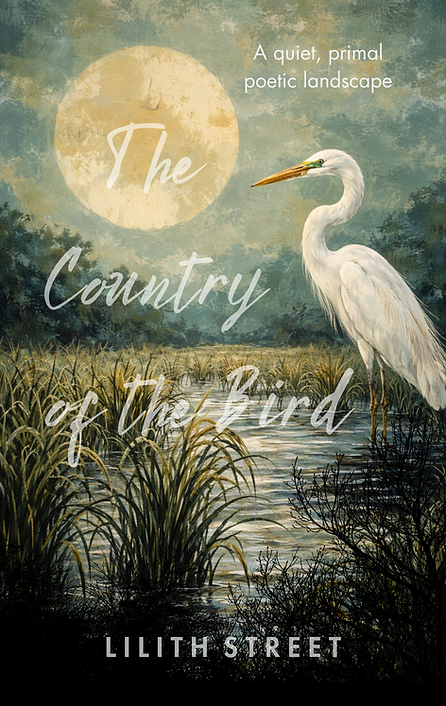
The Country of the Bird
“The mud after birds:
more mud
than before.”
Lilith Street, The Country of the Bird
About the Book
During the late Shang Dynasty, elephants were not limited to the south but inhabited the warmer, wetter forests of the Yellow River valley. Ivory and bronze represented power, wealth, and luxury in contrast to the simple cotton fabric and dulled tools of rice paddy cultivators. To the south, the Yangtze River basin provided an agricultural wetland for agrarian households. In this pre-Buddhist society there was stillness before philosophy, attention before teaching, and consequence before theology.
Here a young poet began her calling by shaping herself after the lotus, and through trips to the river, with moments of resonance and light that echoed natural cycles of emergence and loss. In this sonoric, moving tale, Lilith Street blends historical fiction with poetry, told from the perspective of a Chinese girl. From the elegant movements of the crane to a chrysanthemum snapped clean, traded for a poem, the creatures and flora of ancient China come to life against a transcendental landscape. Under the speaker’s Oracle Bone Script pen, the result is a quiet, haunting zen-aesthetic meditation on attention, innocence, and the cost of seeing.
Potter's Press: 86 pages
Available now

Crane
The crane stands
where the meltwater gathers,
white enough
to borrow the day’s cold.
Not snow—
but what snow becomes
once it decides
to remain.
Its bones are light
because the air insists.
Nothing here is excess.
Even stillness
has been pared down
to what will lift.
When it moves,
the ground forgets
its own weight.
The crane does not rise—
it is taken
by the same force
that loosens clouds.
Lilith Street
Reviews for The Country of the Bird
The Country of the Bird felt less like reading a poetry collection and more like stepping into someone else’s memory. The imagery around the paddies, rain, bowls, reeds, and birds stayed with me long after I finished. I especially loved how the poems trusted silence and restraint. There’s a calmness here that somehow also carries grief underneath it. I can overall say that this collection can be described as beautifully controlled writing . . .
Harmonia, reviewer
I didn’t expect The Country of the Bird to feel this immersive. The setting is so vivid that I could practically hear the rain hitting the roof tiles and picture the water in the paddies. The poems are delicate but never empty. Even the smallest actions like rinsing grain, washing bowls, watching birds, carry emotional weight. This is one of those books that rewards slow reading because every line seems carefully placed.
Bulletproof Girl, reviewer
I like that there’s no melodrama anywhere, but the emotional progression becomes stronger the deeper you get into the collection. The ending left me reflective instead of devastated, which honestly made it more powerful.
Jiminie Mochi, reviewer
What I appreciated most about The Country of the Bird was its consistency of atmosphere. The whole book feels cohesive. I also liked how the poems gradually become more personal while still keeping that restrained tone. It feels deeply intentional from beginning to end.
Max Prime, reviewer
I loved how tactile this poetry collection feels. You can feel the cracked glaze of the clay bowl, the damp sleeves, the mud in the paddies, the steam rising from rice. The physical details make the emotional moments land harder because nothing is overstated. “Clay Bowl” and “Rice” were my favorites because they made ordinary domestic moments feel intimate and meaningful.
Christine, reviewer
The Country of the Bird reads almost like a spiritual coming of age story told through poems. The speaker’s awareness changes over time, and you feel that shift through the way she notices the world around her. I really admired the patience of the writing. These poems never rush toward conclusions. They linger, observe, and allow meaning to build gradually. Definitely not a collection for people who want flashy poetry, but perfect for readers who enjoy subtle emotional depth.
Ruth Tom, reviewer
One thing I really admired about this book was the handling of absence. The poems understand how spaces change after something leaves them. The collection says a lot about attachment without ever becoming overly abstract or difficult to follow. The Country of the Bird has some of the strongest nature writing I’ve read in a while.
Lala Bo, reviewer


״This country is not wide.
It fits inside a glance,
inside the pause
before a bird lifts.״
- Lilith Street